I didn’t set out to become the kind of father who watches his own home like a high-security vault. I told myself it was protection—something a responsible parent would do after loss, after fear, after too many sleepless nights. In truth, it started as suspicion.
I installed twenty-six hidden cameras throughout the house, convinced I was about to catch our nanny doing the bare minimum while my sons needed more than “good enough.” My grief had already turned me hard. I’d built a multi-billion-euro business by trusting numbers, systems, and control—yet none of that could prepare me for the night my world went quiet.
The night everything changed
My name is Damien Beaulieu. I was forty-two and, from the outside, I looked like someone who had everything: success, a stunning home on the French Riviera, and a future that seemed set in stone.
Then my wife, Aurélie—an internationally celebrated cellist—died only four days after giving birth to our twin boys, Mathis and Samuel. The doctors used careful, clinical words, calling it a “postpartum complication,” the kind of explanation that sounds complete until you realize it answers nothing.
I was left alone in our glass-and-light villa, surrounded by silence and two newborns who needed me, while I was barely managing to breathe through the weight of it all.
- Samuel seemed strong and steady.
- Mathis struggled—restless, fragile, and often inconsolable.
- Me—a man trying to parent while still falling apart.
A baby who didn’t seem okay
Samuel ate well, slept in predictable stretches, and looked like the promise of normal life. Mathis was different. His cries came sharp and rhythmic, like an alarm you can’t turn off. Sometimes his tiny body stiffened, and his eyes seemed to drift in a way that made my stomach drop.
A specialist, Dr. Adrien Vela, brushed it off as “ordinary colic.” He said it with the calm of someone who has seen hundreds of exhausted parents and a thousand anxious nights.
But I wasn’t only anxious—I was haunted. Aurélie was gone. And now one of our children looked like he was battling something no one wanted to name.
Grief doesn’t just break your heart. It rewires your instincts—sometimes into something sharp, suspicious, and unfair.
Claire’s pressure—and her agenda
Then there was my sister-in-law, Claire. She had a talent for making concern sound like judgment.
She claimed I was “emotionally distant,” that the twins needed a “proper family environment.” The message underneath her words was clearer than anything she said out loud: she believed I should step aside.
I knew what else was at stake—the Beaulieu Fund, the legacy Aurélie and I had planned to protect for our children. Claire didn’t just want to help. She wanted control.
When Lina arrived
Lina entered our lives quietly, like someone used to taking up as little space as possible. She was twenty-four, studying nursing, and juggling three jobs. She didn’t oversell herself, didn’t demand special treatment, and didn’t ask for a raise after long weeks that would have worn down anyone.
She had only one request: to sleep in the twins’ room.
At the time, I interpreted that request as strange. Later, I would understand it as devotion.
- She spoke gently and rarely.
- She moved like she didn’t want to disturb the house’s sadness.
- She watched the twins with a focus that felt older than her years.
Why I chose surveillance
Claire disliked Lina from the start. One evening over dinner, she leaned close and spoke with the confidence of someone planting a seed.
She said Lina was lazy. She claimed she’d seen her sitting in the dark for hours doing “nothing.” Then she added something worse—suggesting Lina might be taking Aurélie’s jewelry when no one was around.
I should have challenged her. I should have asked for proof. Instead, I listened—because I was exhausted, grieving, and desperate to believe there was a clear villain I could manage.
So I spent €100,000 on one of the most advanced infrared surveillance systems available. I told nobody. Not my staff. Not my family. And certainly not Lina.
I convinced myself it was for the children.
I wasn’t trying to spy on a nanny. I was trying to regain control over a life that had slipped out of my hands.
The recordings I avoided—until I couldn’t
For two weeks, I didn’t watch a single minute. I buried myself in meetings, reports, and deadlines. Work was the only place grief didn’t corner me. At work, I could still pretend I understood how the world functioned.
Then, one rainy Tuesday at three in the morning, sleep refused to come. The house felt too large, too quiet, as if it were holding its breath along with me.
I opened the encrypted livestream on my tablet.
I expected to see Lina asleep.
I expected to catch her scrolling on her phone, ignoring the babies.
I expected—if Claire was right—to see her searching drawers, touching things that didn’t belong to her.
What I actually saw
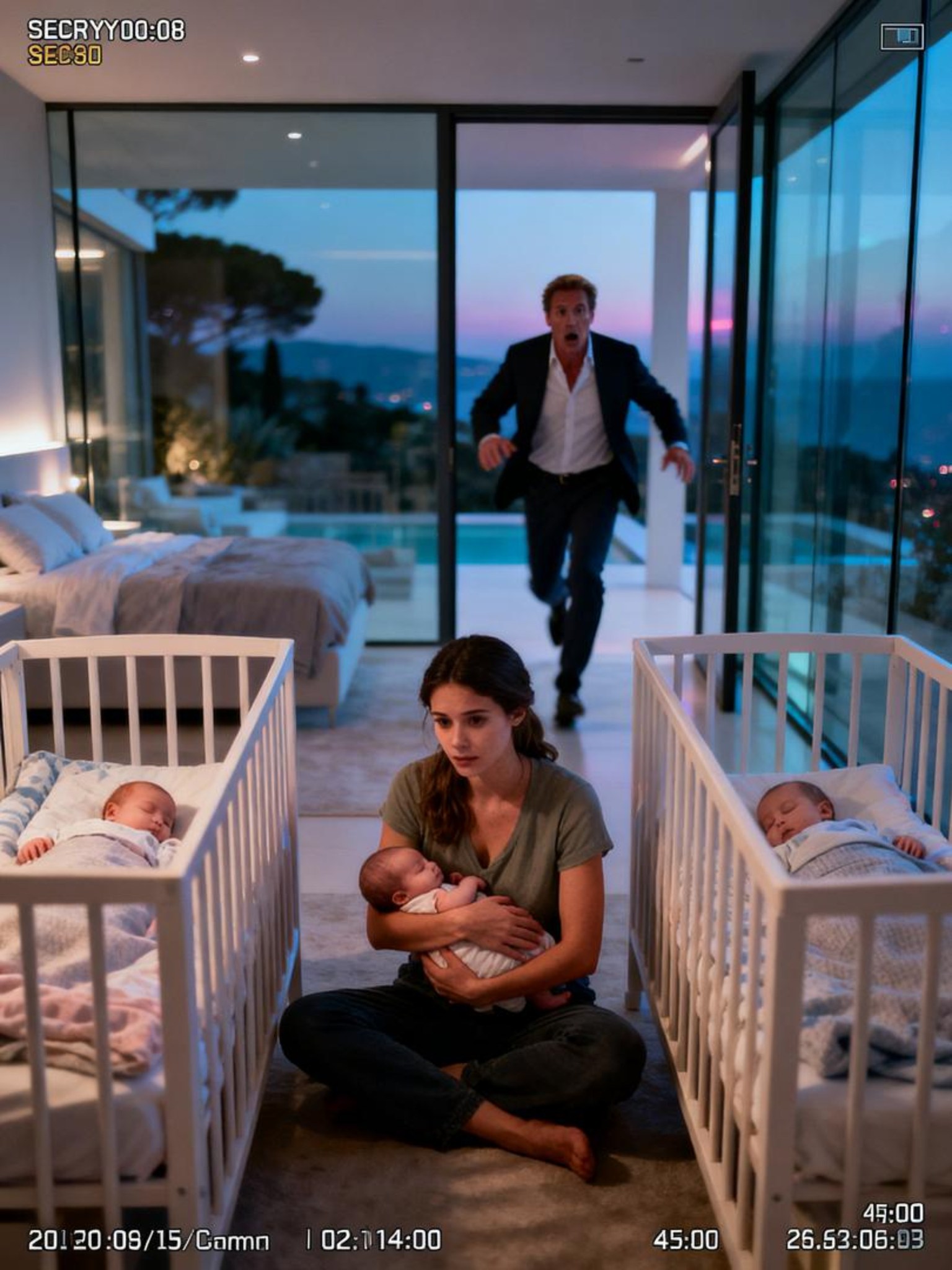
The night-vision footage showed Lina sitting on the floor between the two cribs. She wasn’t resting. She wasn’t distracted. She was fully present.
She held Mathis—my fragile son—against her bare chest, skin to skin, just as Aurélie had once described doing in those first days when she was still here. Lina rocked him slowly, steady as a heartbeat, as if she were lending him calm when his body couldn’t find it on its own.
My throat tightened as I watched. Not because I was angry—because I suddenly felt how wrong I’d been about her.
- She wasn’t avoiding work. She was doing it in the quietest, most intimate way.
- She wasn’t “sitting in the dark.” She was staying still so the babies could settle.
- She wasn’t taking from us. She was giving something I didn’t realize we were missing.
And still, I sensed there was more—something underneath all of it, something I couldn’t name yet.
Because what I saw that night was only the beginning.
Conclusion
I installed cameras expecting to uncover neglect. Instead, the first real thing I discovered was compassion—quiet, careful, and consistent. That footage forced me to question my assumptions, my grief-driven mistrust, and the voices I’d allowed to shape my fears. Whatever the full truth was in my home, it clearly wasn’t as simple as I’d told myself.