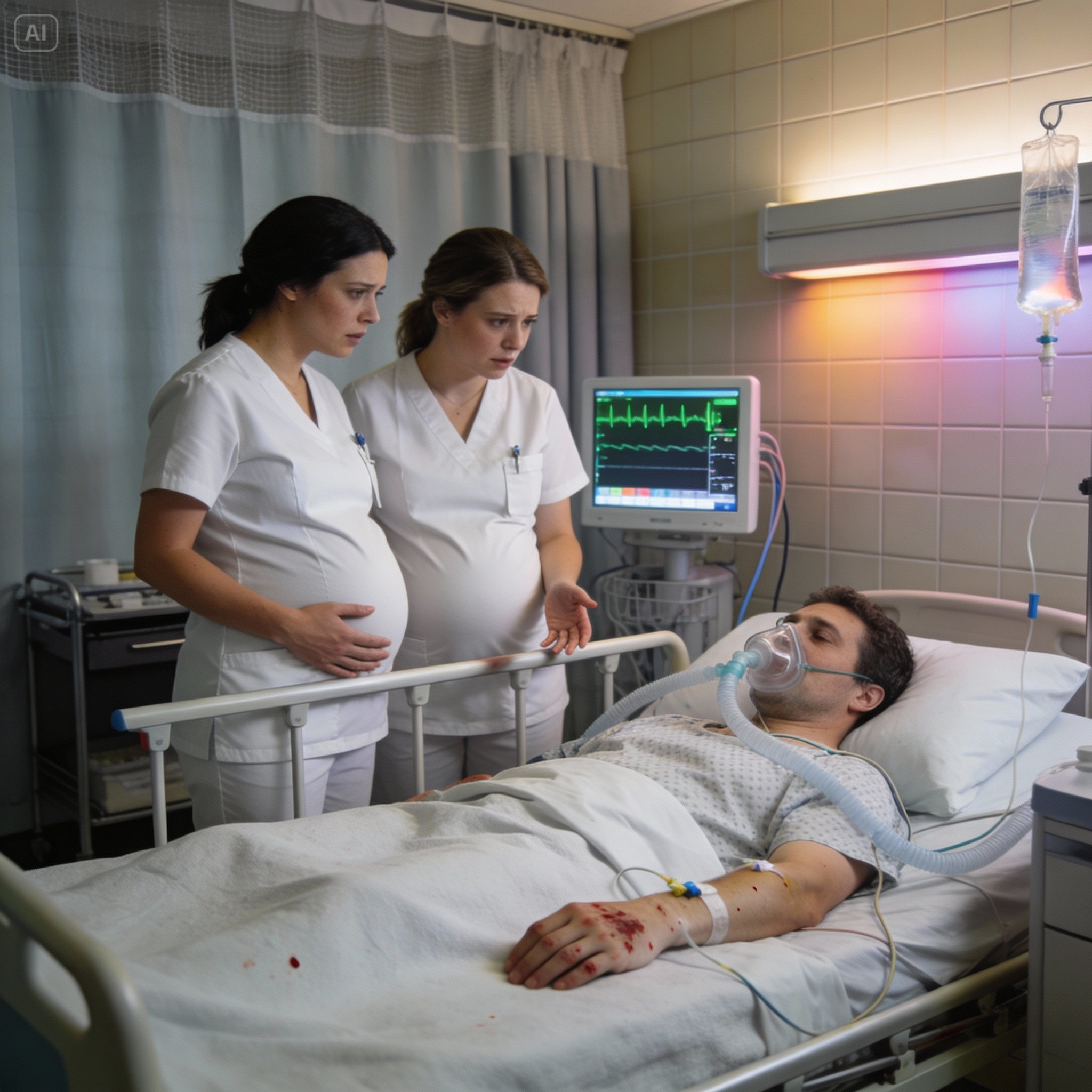
Story Title: Room 412-C
Part 1: The Pattern
Dr. Arjun Malhotra had built his career on one stubborn belief: the brain tells the truth, even when the body lies.
He’d spent fifteen years in neurology watching families cling to miracles and watching medicine crush those miracles with slow, factual cruelty. He believed in scans, in reflexes, in electrical patterns that did not care about prayer. He believed that if you measured something carefully enough, you could understand it.
That belief had gotten him through everything—until the hospital started filling with whispers.
It began the way most scandals begin in places that run on hierarchy: not with a report, but with a rumor.
“They say Rebeca’s pregnant.”

The words slipped through the nurses’ station like smoke. A technician muttered it while printing labels. A resident heard it and laughed once, uncomfortable. A ward clerk pretended not to listen, but wrote the name down anyway, as if collecting it like gossip currency.
Arjun dismissed it at first.
Nurses became pregnant all the time. Hospitals were full of life and loss, and people sought comfort wherever they could find it. Some pregnancies were planned, some weren’t. None of it was his business unless it affected patient care.
But the rumor didn’t die.
It multiplied.
Because Rebeca wasn’t the end.
She was the beginning.
Shanti Memorial Hospital, Mumbai ran like a small city. It had its own gravitational pull: ambulances, visitors, vendors, interns, consultants, and the constant, metallic hum of machines keeping people alive long enough to be saved or lost.
On the fourth floor, at the far end of the neurology wing, was Room 412-C.
A single-bed room with an observation window and a door that shut a little too softly. It was always kept dim, always kept quiet, because the patient inside had not moved in more than three years.
Rohan Mehta.
Twenty-nine years old. Firefighter. Hero, according to the newspapers. The kind of man the public loved because his story fit neatly into headlines: rescued child, fell from burning building, slipped into coma.
He had been unresponsive since.
Minimal brain activity. Stable vitals. No meaningful reflex response. No speech. No wakefulness.
A body maintained by machines and routine.
He lived—or existed—in a limbo that families called hope and doctors called prolonged coma.
Every Diwali, his family sent flowers. Every birthday, they brought sweets and stood at his bedside talking to him as if he could hear. Nurses often remarked on how peaceful he looked, almost serene, like sleep had taken him gently.
Arjun didn’t remark on it.
He’d seen too many “peaceful” comas to romanticize them.
Still, he checked on Rohan regularly. Not out of sentiment, but because long-term coma patients were complicated. They required discipline. And discipline required oversight.
Rohan’s chart was boring, which is what Arjun liked.
No surprises.
No drama.
Until the first “pregnancy” crossed his desk.
It wasn’t even official at first. It arrived as an HR notification, a routine staffing update.
Nurse Rebeca Torres — reassigned to day shift due to pregnancy.
Arjun stared at the message longer than necessary, then moved on.
Two weeks later:
Nurse Mariana Salgado — reassigned due to pregnancy.
Arjun frowned.
Then a month later:
Nurse Yazmín Aguirre — reassigned due to pregnancy.
Then:
Nurse Lidia Rodríguez — reassigned due to pregnancy.
Four pregnancies, all within the same quarter, all among nurses who worked the same rotation pattern: long nights on the neurology wing, frequently covering Room 412-C.
Arjun’s rational mind still tried to shrug it off. Hospitals were big. Schedules overlapped. People dated, lived, made choices. Correlation wasn’t causation.
But then the fifth name landed on his desk.
Ananya Rao.
Ananya didn’t request a schedule change with a smile and a form.
She came into his office in tears.
Arjun looked up from his laptop and saw her standing in the doorway like she didn’t trust herself to step inside.
Her face was pale. Her hair was pulled back too tightly. Her hands shook as she held a small plastic stick.
Positive.
She didn’t sit.
She didn’t speak for a long moment.
Then she whispered, voice cracking, “Sir… I haven’t been with anyone.”
Arjun’s throat tightened.
He stayed calm. That was his job.
“Ananya,” he said gently, “there are many ways a test can be wrong.”
She shook her head hard. “It’s not wrong. I took three.”
Arjun’s eyes narrowed slightly. “Why are you telling me this?”
Because she already knew the answer.
Because she already knew what the rumor was saying.
Ananya’s voice dropped further. “They said it happens to the nurses assigned to him.”
“Him,” Arjun echoed.
She nodded once, eyes shining with fear.
“Room 412-C,” she whispered.
Arjun felt something cold move through him—not supernatural fear, not panic.
Something worse.
The fear of a pattern that shouldn’t exist.
He leaned back, forcing his mind into diagnostic mode.
“Tell me exactly what you mean,” he said.
Ananya swallowed. “They say… every nurse who works long nights in that room starts getting sick. And then… pregnant.”
Arjun’s jaw tightened. “That’s impossible.”
Ananya’s eyes filled. “I know. But it’s happening.”
Arjun held her gaze for a long moment.
Then he asked the question that made her flinch.
“What did you do on those nights?”
Ananya shook her head quickly. “Nothing. I charted. I changed IV bags. I checked vitals. I sat in the chair. I watched him like we’re supposed to.”
Arjun stared at the positive test in her trembling hand.
Then he said the sentence he hadn’t expected to say in his own office:
“Tell me about the room.”
Ananya exhaled shakily. “The lights flicker sometimes. Like… always around the same time.”
“What time?”
She hesitated. “Around 3:40. 3:45.”
Arjun’s skin prickled.
“Anything else?” he asked.
Ananya swallowed. “Sometimes… the monitors spike. Just for a second. Then normal.”
Arjun’s mind began building possibilities.
Electrical surges. Faulty wiring. EMI interference. A bad grounding loop. Someone tampering with equipment. Malfunctioning monitors. Or—
Or the worst explanation: the patient wasn’t as unresponsive as they thought.
Arjun dismissed the thought instantly.
Rohan Mehta hadn’t moved in three years.
He’d personally examined him dozens of times.
But the pattern was now too specific to ignore.
He reached for a notepad and wrote:
3:40–3:45 a.m.
lights flicker
monitor spike
nurse alone
Room 412-C
He looked up at Ananya. “Who else knows this?”
Ananya’s voice dropped to a whisper. “Everyone. But no one says it out loud.”
Arjun exhaled slowly.
Under pressure from the hospital board and fearing a scandal—because rumors about pregnancies and a coma room were the kind that turned hospitals into tabloid material—he decided to act.
Not by asking the nurses more questions.
Not by starting an internal investigation that would leak.
By doing what he trusted most:
measuring reality.
Late on a Friday night, after the final shift handover, Arjun walked down the empty hallway to Room 412-C.
The neurology wing at night felt like a different building. Lights dimmed. Voices low. Footsteps softened by rubber soles and caution. Somewhere far off, a patient coughed. A cart squeaked faintly.
Room 412-C sat at the end of the corridor like a secret no one wanted.
Arjun used his badge to enter.
The smell hit him first: antiseptic and plastic and the faint metallic note of oxygen. The room was dim, lit by machine screens and a small wall light. Rohan lay motionless in bed, eyes closed, hair slightly longer than his admission photos now, face still young in a way that made long-term coma patients look haunting.
Arjun stared at him.
“Either you’re the unluckiest patient in Mumbai,” Arjun murmured, “or something is happening in here that I don’t understand.”
Rohan did not respond.
Arjun crossed to the vent above the corner of the room, pretending to check airflow. In his hand was a small camera—no bigger than a matchbox—borrowed from hospital security under a “theft prevention audit” justification that no one questioned because Arjun had authority.
He slid the camera into the vent’s shadow, angled it carefully toward the bed and the chair beside it.
He tested the view on his phone.
Perfect.
He stepped back, heart pounding.
Not because he believed in ghosts.
Because he believed in crimes.
He turned off the room light, left everything exactly as he found it, and closed the door behind him.
As he walked back to his office, a chilling sensation washed over him—not supernatural, not mystical.
The sensation of stepping onto a path you can’t step off.
Because once you choose to record the truth, you accept that you may not like what you find.
Before dawn, Arjun returned.
He locked himself inside his office, closed the blinds, and connected the storage device to his computer.
The footage loaded.
For several minutes, nothing happened.
Just the steady hum of machines. The occasional shift of the nurse in the chair. Routine.
Arjun’s shoulders began to relax.
Maybe it was faulty tests. Maybe it was rumor hysteria. Maybe—
Then the time stamp hit 3:42 a.m.
The lights flickered.
Arjun leaned forward.
The monitor spike happened exactly as described—numbers jumping sharply, then dropping back as if nothing had occurred.
And then…
Rohan Mehta opened his eyes.
Slowly.
Deliberately.
Not the flutter of a reflex.
Not the random twitch of a brain-stem response.
His eyes opened like a man waking from sleep.
Arjun’s heart slammed into his ribs.
Rohan’s arms lifted—stiff at first, like muscles remembering how to obey. He turned his head toward the sleeping nurse.
Then Rohan sat up.
Fully.
Arjun recoiled in his chair.
The nurse didn’t wake. She remained asleep, chin tilted downward, hands folded in her lap like someone drugged.
Rohan’s gaze moved to the IV stand.
He reached out and adjusted something.
Not clumsily.
Not like a confused patient.
Like someone who knew exactly where the camera wasn’t supposed to be.
Arjun’s hands began shaking.
Then Rohan stood.
Bare feet on tile.
He walked to the nurse.
Arjun’s breath stopped.
Rohan leaned close—not to touch her in a sexual way (nothing explicit happened), but to do something that was somehow worse in its implication: he placed two fingers against her neck, as if checking her pulse… then pressed lightly behind her ear.
The nurse’s head shifted.
She didn’t wake.
Rohan walked back to the bed and lay down again with perfect control. He repositioned his body exactly as it had been. He closed his eyes.
At 3:43 a.m., the monitor returned to baseline.
The lights stopped flickering.
The room returned to stillness.
Arjun sat frozen.
He replayed the footage.
Again.
Again.
Again.
Every time, the same truth: the coma patient wasn’t a coma patient.
He was moving.
At night.
When the room was least observed.
When the nurse was alone.
When the hospital believed routine was safe.
Arjun’s mind raced through possibilities—fraud, drugs, collusion, sexual misconduct, a ring, blackmail, sedation, pregnancy rumors used as cover, lab tampering—
Then his gaze snapped to the nurse’s posture.
She wasn’t sleeping naturally.
She was too still.
Too compliant.
Arjun’s stomach turned.
He grabbed his phone with shaking hands.
He didn’t call hospital security.
He didn’t call the board.
He didn’t call anyone inside the institution that had allowed this to continue for years.
He called the police.
And when the dispatcher answered, Arjun’s voice came out strained and sharp, stripped of doctor calm.
“This is Dr. Arjun Malhotra at Shanti Memorial Hospital,” he said. “I have video evidence of a patient who is supposed to be in a coma walking around at night.”
A pause.
Then, cautiously: “Doctor… are you saying an intruder entered the hospital?”
Arjun swallowed hard, eyes locked on the frozen frame of Rohan’s face—eyes open, looking straight toward the vent, toward the camera, toward the truth.
“No,” Arjun whispered.
“I’m saying the intruder is already in the bed.”
Part 2: The Sting at 3:42
The police didn’t arrive with sirens.
That would’ve been too loud, too visible, too easy for a hospital to spin into a “disturbance.” They arrived the way real investigations arrive when someone suspects the rot is inside the building: quietly, in plain clothes, with calm faces and eyes that didn’t waste motion.
Two officers first—Detective Kavita Deshmukh and Inspector Rao—both carrying the kind of controlled seriousness that made Arjun’s skin prickle. A third followed a few minutes later, a tech specialist with a laptop bag and a look that suggested he’d rather be anywhere else than inside a hospital at dawn.
Arjun met them at a side entrance, cap pulled low, ID badge turned inward as if hiding his own identity could protect him from what he’d started.
He led them to his office and shut the door.
The room smelled like stale coffee and disinfectant. Outside, the hospital was waking. Morning staff arriving. Patients being wheeled to tests. Life continuing as if a man in Room 412-C hadn’t stood up after three years and walked like a ghost.
Arjun didn’t waste time.
He played the footage.
He watched Detective Deshmukh’s expression change—not into panic, not into horror, but into something colder:
Confirmation.
When the clip ended, she said one sentence, calm and lethal.
“That’s not a coma,” she said.
Arjun swallowed hard. “I’ve examined him dozens of times.”
“You examined him when you were supposed to,” Inspector Rao replied. “You didn’t examine him at 3:42 a.m.”
The tech specialist rewound the footage and zoomed in on the moment Rohan touched the nurse behind the ear.
“Pressure point,” he murmured. “Or injection site.”
Arjun’s throat tightened. “You think he’s drugging them?”
Detective Deshmukh didn’t answer that directly.
“Doctor,” she said, “we can’t act on a single clip in a hospital. We need chain of custody, confirmation, and a controlled operation. If your administration is involved, and we come in loud, evidence disappears.”
Arjun nodded. “What do you need?”
Detective Deshmukh leaned forward. “We need to catch him doing it,” she said. “And we need to catch whoever is helping him.”
Arjun’s blood went cold.
Helping him.
Because if Rohan was moving at night, he wasn’t doing it alone. Not in a modern ICU wing with doors, logs, cameras, and shift schedules. Someone had to be looking away. Someone had to be tampering with records. Someone had to be explaining away spikes.
Someone had to be collecting the benefits of this lie.
“What about the nurses?” Arjun asked hoarsely. “The pregnancies?”
Detective Deshmukh held his gaze. “You said you noticed a pattern. We’ll treat it as a pattern. But we don’t build cases on rumors. We build cases on what we can prove.”
Arjun rubbed his face with trembling hands. “What can you prove from this?”
Inspector Rao’s voice was flat. “That your hospital has a man who isn’t supposed to be awake, waking up at the same time every night. That alone is a crisis.”
Detective Deshmukh stood. “We set a sting,” she said. “Tonight.”
Arjun’s heart slammed. “Tonight?”
“Tonight,” she confirmed. “We need the same conditions. Same hour. Same room. Same routine.”
Arjun swallowed. “And the nurse?”
The detective’s eyes narrowed. “We do not use an uninformed nurse,” she said sharply. “We use an officer. Or a decoy medical tech trained and protected. We do this ethically.”
Arjun exhaled shakily, relief mixing with dread.
“Then let’s do it,” he said.
Preparing the Trap
By noon, Room 412-C had been quietly “reassigned.”
Arjun used his authority to order a “monitor calibration” and “infection control deep cleaning,” enough to justify limiting staff access without triggering suspicion. He also ordered that only a minimal night team would be assigned—an excuse he framed as “reducing contamination risk.”
Hospital bureaucracy was easy to weaponize.
The problem was: someone in the building had already been weaponizing it for years.
Detective Deshmukh insisted on two more hidden cameras—redundant angles outside the vent unit Arjun installed. They placed one above the door frame to capture entry. Another near the IV stand to capture tampering.
They also replaced the “sleeping nurse” in the chair with a decoy.
Officer Meera Kulkarni, small and unassuming, trained to hold still and pretend to be vulnerable. She wore scrubs. Her hair was tied back. A faint fake fatigue hung on her posture. Under her sleeve, she had a discreet protective brace.
Under her tongue, a micro-mic.
She would sit in the chair the way the nurses did.
She would “sleep.”
And at the moment Rohan moved, she would signal—quietly.
The plan was simple.
That’s what made it terrifying.
Simple plans break when the enemy has been practicing longer.
Arjun watched Meera settle into the chair during pre-run practice. His stomach knotted.
“This is insane,” he whispered.
Detective Deshmukh didn’t look away from the monitors. “So is leaving it alone,” she replied.
Arjun swallowed.
He thought of Ananya’s tears. Of the HR forms. Of the whispers that had turned into fear.
He thought of the nurses’ faces—ashamed, terrified, confused.
Then he thought of Rohan Mehta’s family bringing flowers every Diwali, praying beside a bed that might not be holding a victim at all.
His hands clenched.
“Who is he?” Arjun whispered.
Detective Deshmukh’s answer was quiet. “We’re about to find out.”
3:42 a.m. Again
The hospital at night breathed differently.
The day staff disappeared. The fluorescent glare softened. Hallways emptied. The quiet became thick and watchful. You could hear elevator cables, distant coughing, the soft squeak of shoes on tile.
Arjun sat in his office with Detective Deshmukh watching the live feed from the hidden cameras. His eyes burned. His mouth was dry. A cup of coffee sat untouched beside his keyboard.
He didn’t want caffeine.
He wanted certainty.
At 3:38 a.m., nothing happened.
At 3:39, the monitor in Room 412-C showed steady vitals. Rohan lay motionless. Officer Meera sat in the chair, head tilted, “asleep.”
At 3:41, the lights flickered once.
Arjun’s heart jumped into his throat.
Detective Deshmukh didn’t blink.
At 3:42—
Rohan’s eyes opened.
Slowly.
Deliberately.
Arjun’s stomach dropped even though he had seen it before.
On the brain activity monitor, the “minimal” pattern spiked sharply—just like last time.
Rohan sat up.
Not groggy.
Not confused.
He moved like someone who had done this many times.
He swung his legs over the side of the bed and stood.
Bare feet on tile.
He didn’t wobble.
He walked directly to the IV stand.
His fingers adjusted something at the tubing junction. Then he reached into a drawer near the bedside cabinet.
Arjun’s breath caught.
He hadn’t known there was anything in that drawer.
Rohan pulled out a syringe.
Arjun’s heart slammed so hard he thought he’d faint.
Detective Deshmukh’s voice stayed calm. “Recording,” she murmured.
Rohan turned toward the sleeping “nurse.”
He stepped closer.
He leaned down.
And then he did it—quick and practiced.
He pressed the syringe behind her ear.
A tiny injection.
Officer Meera’s body shuddered slightly—enough to be realistic, not enough to blow her cover.
Then Rohan adjusted her head gently, like he was tucking her in.
Arjun felt sick.
He’d seen compassion like that from real nurses. From real caregivers.
Seeing it from a man who wasn’t supposed to be awake made it feel monstrous.
Rohan stepped back.
For a moment, he looked at the sleeping figure in the chair.
Then his head turned—slowly—toward the vent.
Toward Arjun’s hidden camera.
For a second, his eyes lingered there.
Not startled.
Not confused.
Aware.
Arjun’s blood ran cold.
Rohan had known he was being watched.
Or he suspected.
Then Rohan returned to the bed and lay down.
Perfectly.
As if nothing had happened.
At 3:43, the monitor returned to baseline.
Silence resumed.
But the building wasn’t silent anymore.
Because now they had proof.
Detective Deshmukh spoke into her radio, voice controlled.
“Move.”
The Door Opens
They didn’t rush in like action movies.
They moved like professionals.
Quiet footsteps. Soft commands. Two officers entered Room 412-C with flashlights held low, not blinding, not dramatic. A third waited at the door.
Arjun watched on the feed, shaking.
Rohan lay “unconscious” again, face serene.
Detective Deshmukh stepped in calmly, stood beside the bed, and said loudly enough for the mic to capture:
“Rohan Mehta.”
No response.
She said it again.
“Rohan Mehta. Open your eyes.”
Silence.
Then Inspector Rao stepped forward and did something simple.
He pressed the bed call button.
The nurse station light blinked in the hall.
“Funny,” Rao said. “He’s responsive when it’s convenient.”
Then Detective Deshmukh reached for the IV line and clamped it.
Rohan’s eyelids fluttered.
Arjun’s breath stopped.
Rohan’s eyes opened—wide and angry now.
Not confused.
Not sick.
Not lost.
He sat up sharply, like the performance had been ripped off him.
“What the hell—” he began.
Detective Deshmukh’s voice cut through.
“Don’t move,” she said.
Rohan froze.
A moment of pure tension.
Then he smiled.
It was a small smile.
Not friendly.
Knowing.
“You finally looked,” he said quietly.
Arjun felt his stomach fall through the floor.
Rohan had been waiting for this.
Inspector Rao stepped forward. “You’re under arrest for assault and unlawful administration of controlled substances.”
Rohan laughed once, soft. “Assault?” he echoed. “You think that’s the crime?”
Detective Deshmukh’s gaze sharpened. “What is the crime?”
Rohan tilted his head slightly. “The crime is what your hospitals do every day,” he said. “They lie. They sell stories. They keep bodies alive for money. I just learned to do it better.”
Arjun’s mouth went dry.
“What are you talking about?” he whispered, unable to stop himself.
Rohan’s eyes flicked to the camera in the vent as if acknowledging Arjun personally.
“You’re the neurologist,” he said. “The one who believed the chart.”
Arjun flinched.
Detective Deshmukh didn’t allow the conversation to drift. “Cuff him.”
Two officers moved in quickly.
Rohan didn’t resist.
That made it worse.
As they cuffed him, he leaned back against the pillow and said, almost casually:
“You should check the medicine cabinet. The one that never gets audited.”
Arjun’s blood went cold.
Detective Deshmukh turned toward the camera. Toward Arjun in his office.
“Doctor,” she said sharply, “get down here. Now.”
Part 3: The Cabinet That Never Got Audited
Arjun ran.
Not the neat, controlled walk he used in hospital corridors. Not the brisk stride of a doctor late to rounds. He ran like a man who had finally seen the underside of his own profession and couldn’t pretend the floor was solid anymore.
He took the stairwell instead of the elevator. The pounding of his shoes on concrete sounded too loud in the sleeping hospital, like the building itself should have woken up and stopped him. His badge swung against his chest. His hands shook so badly he nearly missed the door to 412-C.
When he pushed it open, the room felt colder than it had on the camera feed.
Detective Deshmukh stood near the bed, posture perfectly still, eyes sharp. Inspector Rao was speaking quietly into his radio. Officer Meera sat upright now, her “sleep” gone, rubbing the injection site behind her ear with controlled anger.
And in the bed, cuffed to a rail, sat Rohan Mehta.
Awake.
Watching.
His serenity was gone. In its place was a calm that looked practiced—like a man who had lived inside a lie so long he didn’t fear exposure anymore.
“Doctor,” Detective Deshmukh said sharply when she saw Arjun, “he mentioned a cabinet.”
Arjun swallowed hard. “The medicine cabinet?” he whispered.
Rohan’s smile returned—thin, unsettling.
“The one you never count,” he said softly. “Because you trust your people.”
Arjun’s stomach turned.
He moved to the built-in cabinet near the sink. Every room in this wing had one. It held basic supplies—saline flushes, syringes, topical antiseptics, sometimes emergency meds depending on patient needs.
This cabinet was supposed to be logged and audited.
Supposed to be.
Arjun unlocked it with the standard key hanging on the wall—standard access, standard routine.
He opened the door.
At first, it looked normal.
Saline bags, neatly stacked.
Gauze.
IV connectors.
A tray of sealed syringes.
Then he noticed the labels.
They were too clean. Too uniform. A brand Arjun didn’t recognize.
He reached in and pulled one box out.
No hospital inventory sticker.
No barcode matching their system.
Just a blank white label with printed black numbers.
Arjun’s breath hitched.
“These aren’t ours,” he whispered.
Detective Deshmukh stepped closer. “Bag it,” she ordered.
The tech specialist moved in with evidence bags and gloves.
Arjun kept searching.
Behind the saline bags was a smaller compartment.
He slid it open.
And felt his blood run cold.
Inside were vials.
Amber glass.
The kind of vials that didn’t belong in a bedside cabinet.
The labels were partially scratched off, but Arjun didn’t need perfect text to recognize the shape and color.
Sedatives.
Fast-acting ones.
The kind used in anesthesia and emergency sedation.
The kind that could make a nurse “sleep” deeply and wake up with no memory if dosed carefully.
Arjun stepped back, heart hammering.
“Who stocked this?” he whispered.
Rohan laughed softly in his cuffed bed.
“The same people who kept calling me ‘coma boy’ while they cashed the checks,” he said.
Arjun turned on him, voice breaking. “What checks?”
Rohan’s eyes glittered with something close to contempt.
“You think I stayed here for three years because of my hero story?” he asked. “That’s what they told my family. That’s what they sold the donors. That’s what they sold the hospital board.”
His voice dropped lower.
“But I stayed here because I was profitable.”
Arjun’s stomach twisted.
Hospitals did profit from long-term patients—insurance reimbursements, donations, grants tied to “research,” public goodwill.
But this?
This sounded like something else.
Detective Deshmukh’s voice was cold. “Who is ‘they,’ Rohan?”
Rohan leaned his head back against the pillow, eyes half-lidded as if remembering fondly.
“Start with the night supervisor,” he said. “Then the billing manager. Then the man who signs off on my ‘coma assessments’ when you’re not here.”
Arjun’s breath stopped.
Coma assessments.
Only neurologists and specific senior physicians could sign those.
Arjun’s mind raced through his department list.
He thought of Dr. Sanjay Kulkarni—senior attending, charming, politically connected, the type who hosted hospital board members at his daughter’s weddings and always seemed to know which way the wind would blow.
He thought of how Dr. Kulkarni insisted on “continuity” with Rohan’s case when Arjun traveled.
He thought of how Rohan’s chart always looked perfect when Arjun returned.
Minimal brain activity. Stable vitals. “No change.”
No change because someone ensured no change.
Arjun swallowed hard.
“Pull the chart,” he whispered.
Inspector Rao gestured to an officer. “Get all records for 412-C. Originals. Digital logs. Sign-off history. Now.”
The officer moved fast.
Detective Deshmukh turned to Arjun. “Doctor, has anyone ever questioned why he stayed in this wing so long?”
Arjun’s mouth felt dry.
“It was… justified,” he whispered. “Long-term coma patients are sometimes held in special monitoring if the family requests—”
Detective Deshmukh cut him off. “That’s policy. I’m asking about reality. Was he bringing money in?”
Arjun didn’t answer fast enough.
Because yes.
He was.
Rohan’s case was famous. A firefighter hero. A “miracle patient.” Donations came in every Diwali. News segments ran about hope. The hospital’s charitable arm raised funds with his story.
And if he died, the story ended.
Rohan’s smile returned.
“You get it,” he whispered.
Arjun’s hands clenched into fists.
“You were drugging nurses,” Arjun said, voice shaking. “Why? What does that have to do with money?”
Rohan laughed again, and the laugh was almost pitying.
“Pregnancy rumors,” he said. “Confusion. Scandal. Distraction.”
Arjun went rigid. “You’re saying the pregnancy thing was… a cover?”
Detective Deshmukh’s eyes narrowed. “Explain.”
Rohan shrugged slightly, the cuffs clinking. “A nurse complains about something weird? About lights flickering? About a patient moving?” He smiled. “You let the rumor become something ridiculous. You make everyone whisper about miracles and ghosts and pregnancies and shame.”
His voice was calm, like he was describing an equation.
“And while everyone is distracted,” he continued, “the real theft continues.”
Arjun felt nauseated.
This wasn’t a haunting.
It was manipulation.
Rohan looked at him directly.
“You wanted science,” he said softly. “Here it is: humans believe what entertains them. They ignore what indicts them.”
Arjun’s jaw trembled.
Detective Deshmukh stepped closer to Rohan’s bed. “Where did the sedatives come from?” she demanded.
Rohan tilted his head, thinking. “The hospital,” he said. “And outside. A pharmacy contract. A ‘donation’ line item. You hide it inside supply orders.”
Arjun’s pulse spiked. “That would require purchasing approval.”
Detective Deshmukh’s voice was cold. “And someone with authority.”
Rohan’s eyes flicked toward Arjun, and he said the name like a match being dropped.
“Kulkarni.”
Arjun felt the room tilt.
Dr. Sanjay Kulkarni.
A respected physician.
A board darling.
A man who shook hands with politicians and spoke about ethics at conferences.
Arjun’s throat closed.
“You’re lying,” Arjun whispered, though it didn’t sound convincing even to him.
Rohan smiled. “Check the signatures.”
The Paper Trail
At 5:12 a.m., the officer returned with printouts and a laptop.
Inspector Rao opened the digital log.
Every coma assessment. Every sign-off.
Arjun watched the screen, eyes burning.
And there it was.
Dr. Sanjay Kulkarni’s signature.
Repeated.
Week after week.
During times Arjun wasn’t there.
Assessments that should have included detailed neurological exams but were stamped with the same language:
“No significant change. Continue supportive care.”
No significant change because no one allowed it.
Detective Deshmukh’s face hardened.
She turned to Inspector Rao. “Bring him in.”
Inspector Rao nodded once and spoke into his radio.
Arjun felt his knees weaken.
Dr. Kulkarni was not a small fish.
He was a man who could destroy Arjun’s career with a whisper if this went wrong.
And yet—if this was true—Dr. Kulkarni had been destroying something far worse than careers.
He’d been destroying trust in medicine itself.
The Arrest That Shook the Wing
Dr. Kulkarni arrived at 6:03 a.m., pulled from his home in a hurry, still wearing a pressed shirt beneath his coat like he’d tried to dress for dignity.
He stepped into 412-C and stopped when he saw police.
His gaze flicked to Arjun.
Then to Rohan.
Then to the cabinet open, evidence bags filling with vials.
For a moment, his composure held.
“Arjun,” he said softly, as if talking to a junior colleague who’d made a mistake, “what is this?”
Detective Deshmukh answered for him.
“Dr. Sanjay Kulkarni,” she said, “you are being detained for questioning in connection to controlled substance diversion, falsification of medical records, and conspiracy.”
Kulkarni’s face tightened.
“This is absurd,” he said. “I—”
Inspector Rao held up the printouts.
“Your signature,” he said. “Repeated coma assessments. You authorized continued care. You approved supply orders for sedatives stored in a bedside cabinet.”
Kulkarni’s eyes flicked to the paper.
Then back to Arjun.
His voice dropped into something colder.
“You did this,” he whispered. “You don’t understand what you’re touching.”
Arjun’s voice finally broke free.
“I understand exactly what I’m touching,” he said. “A patient who wasn’t in a coma. Nurses who were drugged. A hospital that became a machine for profit.”
Kulkarni’s jaw clenched.
Rohan chuckled softly from the bed.
“Tell them about the donations,” he murmured. “Tell them about the board dinners.”
Kulkarni’s nostrils flared.
Detective Deshmukh signaled.
Cuffs clicked.
Kulkarni’s face went pale as his wrists were restrained.
The sound of handcuffs in a hospital room was wrong.
It was the kind of wrong that changes institutional memory forever.
As he was led out, Kulkarni turned his head slightly, eyes cold on Arjun.
“This will ruin you too,” he whispered.
Arjun stood very still.
“Then it should,” he replied.
The Room That Stayed Awake
Room 412-C was sealed that morning.
Not quietly. Not politely.
A red sign was placed on the door: RESTRICTED — LAW ENFORCEMENT HOLD.
Rohan was transferred to an isolated wing under guard.
The hospital issued an internal memo calling it “a technical irregularity and patient safety concern.”
The press got a sanitized version: “Security review underway.”
Families never got the full story.
That was the compromise institutions make: enough truth to survive, not enough to confess.
But Arjun knew what he’d seen.
He had watched a man stand up after three years of stillness.
He had watched a respected physician’s signature become evidence.
He had watched nurses become pawns in a scheme designed to keep money flowing.
That night, Arjun went home to his apartment and sat on the floor in the dark.
His medical license was still valid.
His reputation wasn’t.
His belief in medicine as a clean system was gone.
At 3:43 a.m., his phone buzzed.
A message from Detective Deshmukh:
We’re moving evidence storage. The monitor unit blinked again. It was unplugged. Tech says it shouldn’t.
Arjun stared at the text for a long time.
Not because he believed in ghosts.
Because he believed in systems.
And systems, once corrupted, sometimes behave like hauntings—persisting even after you cut the power.
He wrote his resignation letter the next morning.
Three sentences.
“I am resigning effective immediately. I cannot continue under these ethical conditions. Thank you for the opportunity to serve.”
He emptied his office the same day.
He didn’t take trophies.
He took only one thing: a printed still-frame from the hidden camera footage—Rohan’s eyes open, looking straight toward the vent.
A reminder that the truth had been watching him back.
And then Arjun Malhotra left Mumbai.
No goodbye.
No explanation.
Just a ferry ticket to a remote island in Kerala, where temples were older than reputations and silence didn’t feel like complicity.
Behind him, Shanti Memorial Hospital repainted the story.
Room 412-C became a storage space. Then an office. Then empty again after repeated complaints of “equipment malfunction.”
And somewhere deep in evidence storage, a red monitor light blinked intermittently even when disconnected—until it disappeared from inventory completely.
Officially, the recordings were “inconclusive due to artifacting.”
Unofficially, everyone who had seen the footage stopped walking past 412-C alone.
Because the room didn’t feel haunted.
It felt occupied.
Not by a ghost.
By the memory of a lie that had breathed for three years.
And by the knowledge that some doors, once opened, don’t slam shut.
They wait.
THE END